

If you’ve spent any time researching custom RVs or camper vans, you’ve probably noticed a pattern. Lots of inspiration. Very few straight answers on price.
We get it. “It depends” is technically true, but it’s not helpful when you’re trying to figure out if a custom build is even in the realm of possibility.
We build custom vans every day. Fully finished, off-grid, live-in rigs that people rely on for travel, work, and family adventures. So let’s talk honestly about what a custom RV actually costs, what drives those numbers, and where people are most often surprised.
First, what do we mean by “custom RV”?
For this conversation, we’re talking about Class B-style custom camper vans, built on platforms like:
Mercedes Sprinter
Ford Transit
Ram ProMaster
At ChexVanz, we build both:
Fully custom vans, designed from the ground up around how you live and travel
Semi-custom builds, where we use proven layouts and components to control cost or timeline
This article focuses primarily on fully custom builds, since that’s what most people mean when they ask this question. We’ll also explain where semi-custom can make sense.
The short answer on cost
Here’s the honest range we see in the real world.
The lowest realistic starting point
For a fully finished van with HVAC and a shower, the lowest realistic starting point we see is around $60,000 for the build.
That is not a luxury build. It is clean, simple, and functional.
That number moves quickly depending on your choices, especially around the bathroom and power system.
For example:
A fully enclosed, waterproofed shower means constructing an entirely sealed room. That adds labor and materials.
A fold-away shower, like a Tetra Van system, can reduce cost because we’re not building a permanent enclosure.
Water heaters range widely. A smaller unit saves money compared to a $1,000 Isotemp 4.2-gallon heater.
Once you add air conditioning, we recommend a minimum of 540Ah of battery capacity. Anything less and the system drains too quickly to be practical.
The most common range we see
Most of our clients land in the $90,000 to $100,000 range for the build.
That typically includes:
Robust electrical and charging systems
Quality cabinetry and finishes
Heating and cooling
A well-designed galley
Comfortable sleeping and seating
Smart storage
No major compromises
This is the range where people feel good using their van long-term without wishing they had done things differently.
High-end, no-compromise builds
When clients truly remove limits, pricing can land anywhere from $150,000 to $300,000+ for the build.
Costs climb quickly when you stack features like:
Large fridge and freezer combos in the $5,000 to $6,000 range
Extensive exterior upgrades such as awnings, roof racks, side steps, rear storage boxes, and ladders that can reach $30,000 to $50,000
Wheels, tires, suspension, anti-sway systems, winches, and lighting
Premium off-road lights that can cost hundreds per light
Massive battery and water systems
Starlink, cell boosters, multiple TVs, convection ovens, and high-end seating like Scheel-Man leather seats
At this level, you are building a rolling home, not a weekend camper.
What about the van itself?
The numbers above are build cost only.
For the vehicle:
A new Mercedes Sprinter typically runs $60,000 to $80,000
A new Ford Transit often starts around $45,000
Starting with a pre-owned van can save money, but it requires careful planning. For example, if you want specific operable windows, buying a van loaded with fixed factory glass can actually cost more in the long run. Removing and replacing windows adds labor and reduces insulation performance.
Buying the right van up front matters more than people realize.
What actually drives the cost of a custom RV?
No single feature blows the budget on its own. It’s the stacking effect.
Power systems
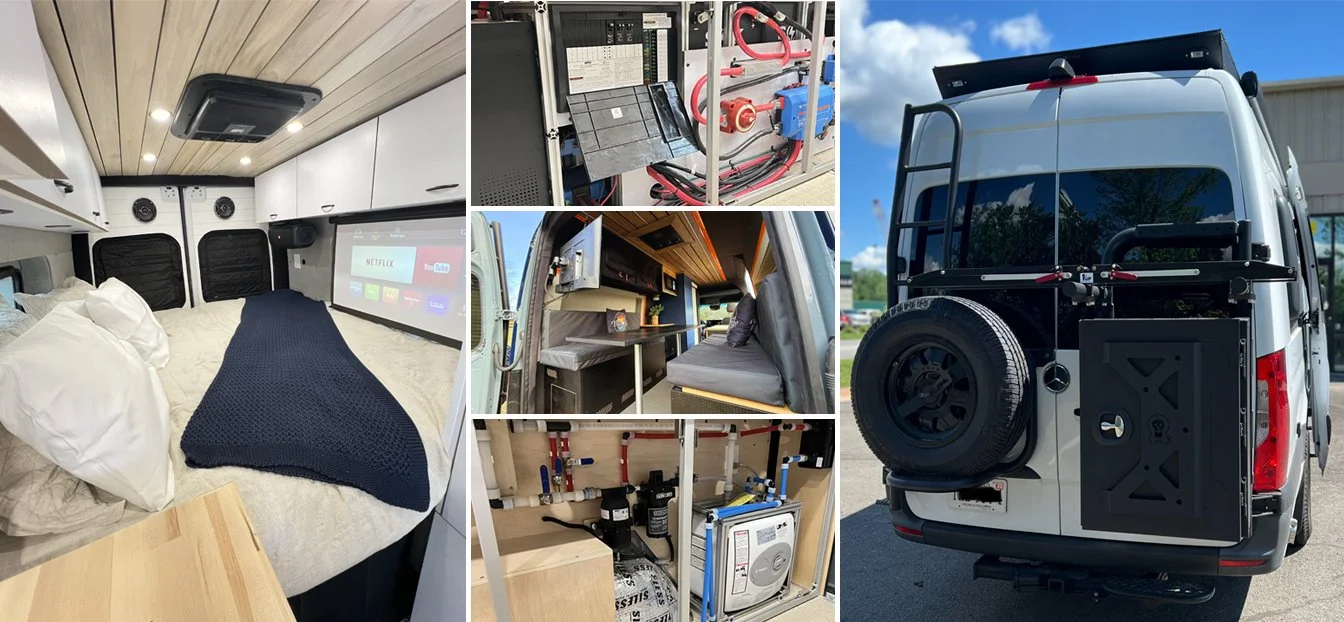
Solar requires a roof rack.
Roof racks require proper mounting and waterproofing.
Solar needs charge controllers.
Alternator charging requires heavy-gauge wiring and careful installation.
A power system is not just batteries and panels. It’s all the invisible work that makes it safe and reliable.
Bathrooms
A bathroom is never “just a bathroom.”
It’s a full water system:
Fresh and gray tanks
Pumps and accumulators
Plumbing, which we build with Uponor so it survives all climates
Strategically placed under-van tanks
Motorized ball valves for controlled dumping
That complexity is what surprises people most.
Materials and finishes
Finishes vary widely:
Lonseal marine flooring averages about $1,000
High-pressure laminate cabinetry pricing depends on color and supplier
Corian countertops are roughly double the cost of butcher block
None of these choices are wrong. They just change the total.
Labor and lead time
A good rule of thumb is that labor often comes close to matching material cost.
If a build has $50,000 in components, expect $40,000 to $50,000 in labor.
We’re a boutique builder. We’re not producing 20 identical vans a year. A full custom build typically takes 4 to 6 months, sometimes longer depending on complexity and parts availability.
Cost and lead time are the two things buyers underestimate every time.
Semi-custom vs fully custom
There are times when semi-custom makes sense.
We completed three vans for Amazon disaster relief under extremely tight deadlines. To hit the schedule, we used pre-manufactured galley and dinette components shipped from out west. It saved labor time and worked well for that specific application.
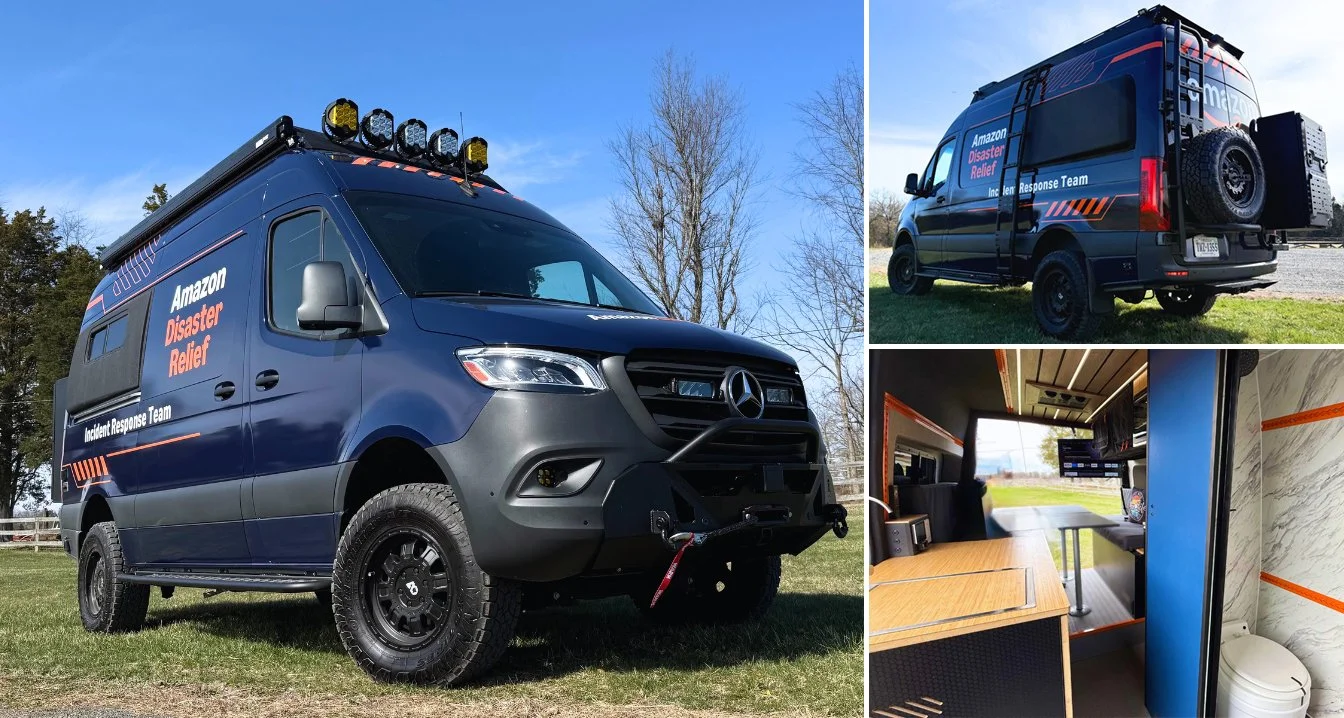
The trade-off was reduced customization. Pre-made solutions don’t fit every layout or lifestyle.
Fully custom gives you flexibility. Semi-custom can save time and money when your needs align with proven designs.
Common misconceptions we see all the time
Exterior upgrades are often underestimated. Seats, racks, steps, and accessories add up fast.
Bathrooms are almost always bigger and more expensive than expected.
People assume systems cost less because they don’t see them. Electrical and plumbing live behind walls, but they matter most when something goes wrong.
Is a custom RV worth it?
In our opinion, yes, if you want a reliable, long-term, off-grid vehicle and ongoing support.
We regularly get calls from people who bought vans or RVs elsewhere and can’t reach the company that built them. We don’t disappear after delivery.
Who should not buy a custom RV?
If you’re extremely budget-conscious, a full custom build may not be the right fit. Even just finishing walls, ceilings, and flooring can run $5,000 or more before systems are added.
When does a custom van make more sense than a factory RV?
Easier storage
Ability to park almost anywhere
True off-grid capability
More flexibility in how and where you travel
RVs often require campgrounds. Vans don’t.
One last piece of advice
If you’re serious about a custom build, talk to a builder before you buy a van.
The right decisions early can save you thousands and months of frustration later.
If you’re exploring a custom RV or camper van and want an honest conversation about budget, trade-offs, and what actually makes sense for how you travel, reach out to ChexVanz. We’re happy to talk through it before you spend a dollar.